When a relative falls ill, ages, and becomes dependent on constant care, the toughest decision that any family faces is the choice between having the care at home and in the hospital. Both facilities provide quality healthcare services but the use of either depends on the condition of the patient, his/her health requirements, preference, and financial capabilities.
However, in case of emergency care, surgical procedures, intensive care and many other medical interventions which cannot be done at home, the importance of the hospital cannot be overlooked. Hence, knowing the difference between Home Care vs Hospital Care is important in order to make the right healthcare choice.
In cases where you need Elderly Care Service Bangladesh, a Patient Care Service at Home, post-surgery care, or any nursing care in the long run, the knowledge about the pros and cons of the above-mentioned healthcare alternatives could be beneficial for the patients as well as the families.
In the following sections of this article, we will discuss all the differences between home and hospital care at length.
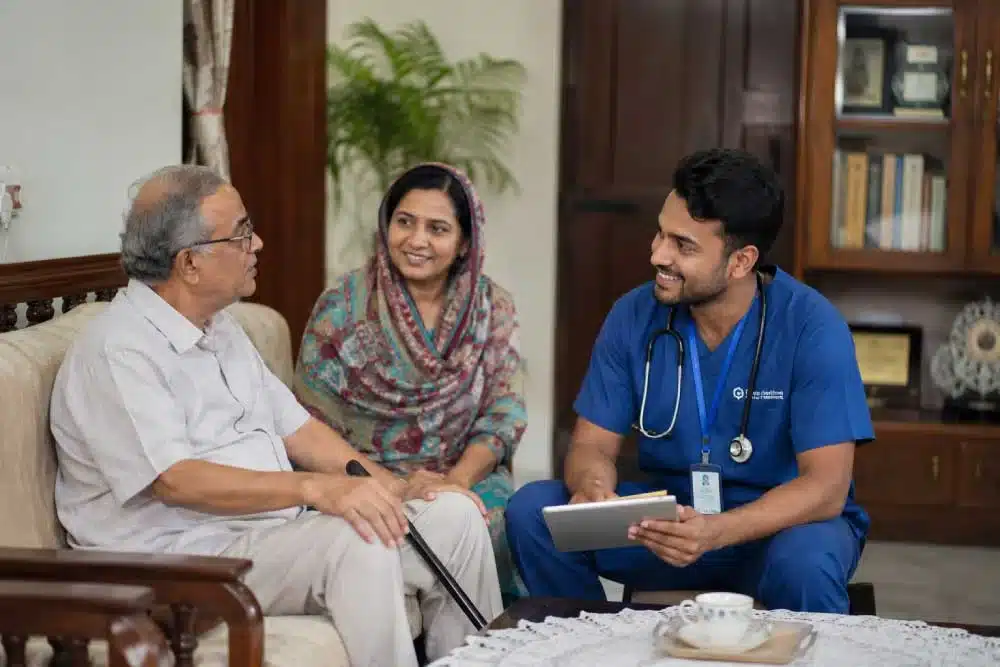
Understanding Home Care Services
Home care is the term used to define professional healthcare and personal assistance to the patients at their own home. The objective of home care services is to assist individuals in regaining their health from any disease, managing any chronic disorder, elderly care or maintaining their independence without going to hospitals unnecessarily.
Development of Modern Home Care Services in Bangladesh has gone way beyond basic care giving. Now, patients get access to skilled caregivers, nurses, physiotherapists and healthcare assistants.
Common home care services include:
- Elderly patient care
- Bedridden patient support
- Home nursing service
- Post-surgery home care
- Medication management
- Mobility assistance
- Personal hygiene support
- Physiotherapy sessions
- Chronic disease monitoring
- 24-hour caregiver service
Personalized attention is one of the key benefits offered by home care. Unlike in hospitals, where healthcare professionals have to divide their attention amongst several patients, in home care, there will be a full-time caregiver attending to just one patient at all times.
The other benefit offered by home care is that the patient gets to stay in a familiar environment. This helps greatly to cut down stress and anxiety, especially for aged persons who have difficulties adapting to a new environment like a hospital.
Patient Caregiver Service provides services in a manner that maintains the dignity and independence of the patient, as well as keeps them emotionally stable. This is made possible because the family member continues being involved in the entire process.
It is because of this reason that the use of home care has been increasing in Bangladesh.
Understanding Hospital Care
Hospital care refers to medical care offered by a healthcare institution in the presence of doctors, specialists, and other medical staff. Hospitals are fitted with all the latest technological equipment needed for the diagnosis and treatment of various health problems.
Hospital care is particularly important when patients require:
- Emergency medical treatment
- Surgical procedures
- Intensive Care Unit (ICU) support
- Continuous medical monitoring
- Specialized treatments
- Advanced diagnostic testing
- Complex medical interventions
Hospitals provide an opportunity to have access to multidisciplinary healthcare teams who can react to any changes in a patient’s condition very quickly. In case of trauma, heart attacks, strokes, problems with breathing, etc., hospitals remain the safest place for treatment.
On the other hand, staying in the hospital for too long may pose certain difficulties. First, patients usually feel stressed out, lose their privacy, have difficulties with sleeping and the risk of acquiring infection in the hospital is significantly increased. Moreover, family members rarely have an opportunity to assist the patients in their everyday activities.
In terms of long-term recovery and non-critical healthcare needs, staying at the hospital does not necessarily remain the best choice in terms of money. There are many people who do not need intensive medical help anymore but can recover by using professional Nursing Home Care BD services.
The main benefit of being in the hospital lies in an immediate treatment that cannot be provided anywhere else except for the hospital. Thus, it is clear why hospitals play such an important role in acute treatment and home care prevails in recovery.
Home Care vs Hospital Care Comparison Table
| Factor | Home Care | Hospital Care |
|---|---|---|
| Environment | Comfortable home setting | Clinical medical environment |
| Personal Attention | One-on-one caregiver support | Shared attention among multiple patients |
| Family Involvement | High | Limited |
| Cost | Generally lower for long-term care | Higher for extended stays |
| Infection Risk | Lower | Higher exposure risk |
| Comfort Level | Very high | Moderate |
Benefits of Home Care Services
There are numerous physical, emotional, and economical reasons to seek home healthcare services.
First, there is the aspect of comfort. Patients have been found to heal faster and easier when treated in their own familiar surrounding and among their beloved family members and personal possessions.
Second, personalized attention of professional caregiver gives an opportunity to create routine tailored to patient’s specific needs, preferences, and health state.
Third, home care makes people independent. Senior citizens receiving Senior Care Services usually have better freedom in conducting their daily routines.
Economically speaking, professional home care might be less expensive than hospitalization because families can order care services for just some hours per day up to 24 hour caregiver services.
Furthermore, one cannot ignore the absence of infection risk in home surroundings. There is no doubt that infections are particularly harmful for patients who are elderly or have some immunity system disorders.
Finally, when it comes to surgical treatment, professional Post-surgery home care can assist in managing medication regime, mobilizing patient, helping with his/her wound care, and giving recommendations concerning rehabilitation process.
All these advantages make people opt for professional Caregiver Service Bangladesh providers.
When Hospital Care Is the Better Choice
While home care has its benefits, there are cases when the care in hospitals is the most appropriate one. Hospitals are equipped for dealing with emergencies and complicated medical problems.
People having a heart attack, stroke, severe infection, breathing difficulties, serious injuries, or other complications should be taken to a hospital immediately. In such cases, people need a qualified medical staff, as well as the use of certain equipment which is found only in hospitals.
Thus, even though home care is better suited for those people who do not have any serious problems, but just need help, hospital care is better in cases of illnesses, emergency situations, operations, etc. The optimal health care is a combination of both hospital care and home-based rehabilitation.